

WPC VS SPC Flooring In-depth Analysis:Purchasing Decisions
When selecting durable, waterproof flooring for homes or commercial projects, WPC (Wood Plastic Composite) and SPC (Stone Plastic Composite) flooring consistently rank among the top choices. Both belong to the rigid-core luxury vinyl plank (LVP) category, offer realistic wood or stone designs, feature click-lock installation, and deliver 100% waterproof performance.
However, their core constructions differ significantly, which affects underfoot feel, durability, dimensional stability, installation requirements, cost, and ideal applications.
There is no universal “better” option. The right choice depends on your priorities: comfort and quietness, or maximum rigidity, impact resistance, and long-term stability.This guide provides a detailed side-by-side comparison of structure, performance, cost, and real-world suitability for both residential and commercial spaces to help you make a confident purchasing decision.
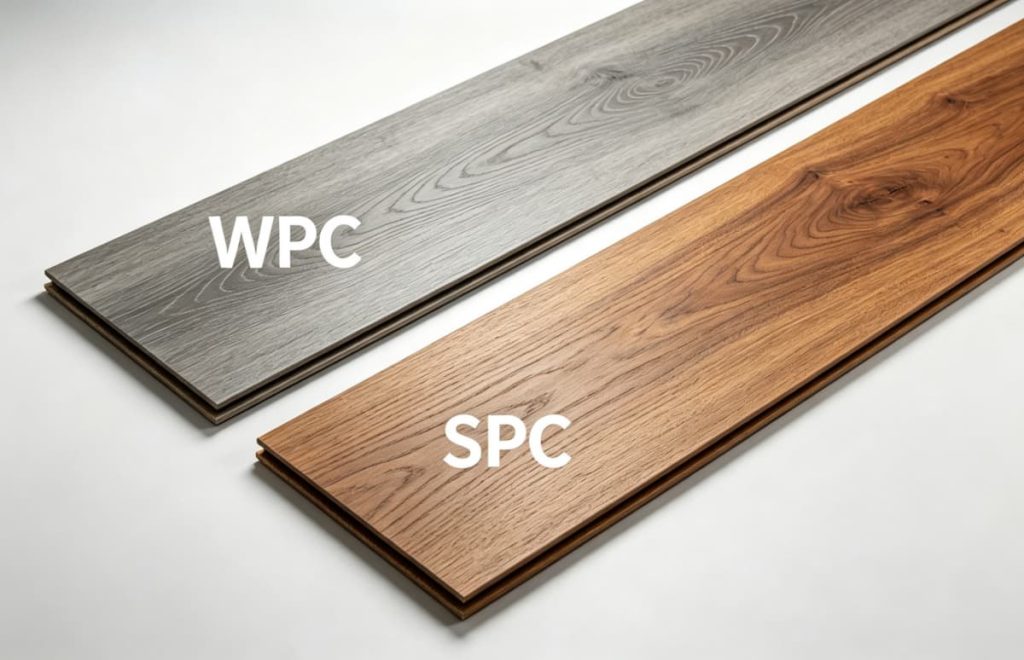
Table of Contents
What Is SPC and WPC Flooring?
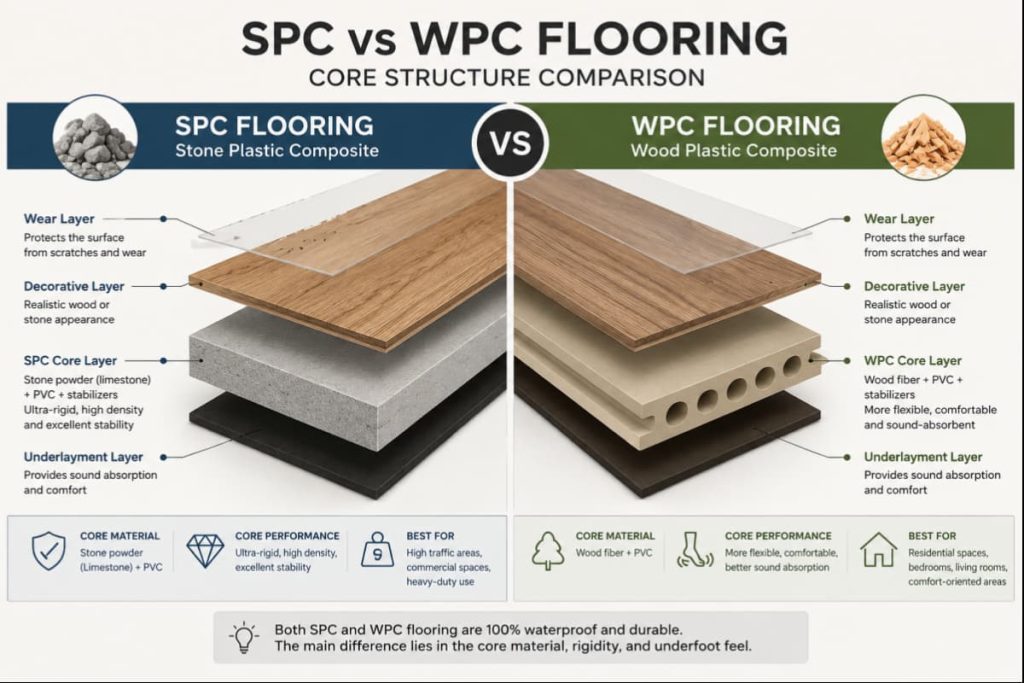
Both SPC and WPC are rigid-core vinyl floors. The main performance differences come from the core layer:
- SPC (Stone Plastic Composite): Made primarily from limestone powder (calcium carbonate, typically 60–75%) + PVC. It is a high-density, non-foamed rigid core. The result is a hard, stable, and highly impact-resistant plank.
- WPC (Wood Plastic Composite): Made from wood flour or cornstarch powder + PVC + foaming agent. The foamed core creates a lighter, more elastic structure that feels softer and warmer underfoot, closer to real wood.
In simple terms: SPC is denser and more rigid; WPC is thicker, softer, and more cushioned. Surface layers (wear layer and decorative film) are similar, so core material drives most performance differences.
WPC vs SPC Flooring Comparison Table
| Comparison Factor | SPC (Stone Plastic Composite) | WPC (Wood Plastic Composite) | Winner / Verdict |
| Core Material | Limestone (60–75%) + PVC, non-foamed | Wood/bamboo flour + PVC + foaming agent | — |
| Core Density | Very high (approx. 1.8–2.1 g/cm³) | Moderate to low (approx. 0.5–1.4 g/cm³) | SPC denser and harder |
| Typical Total Thickness | 4–6.5 mm | 6–8.5 mm+ | WPC thicker |
| Waterproof Performance | 100% waterproof (inorganic core, almost zero absorption) | 100% waterproof (foamed core needs good edge sealing) | Nearly equal, SPC slightly better |
| Underfoot Feel & Comfort | Firm, cooler, similar to thin tile | Softer, warmer, cushioned, closer to real wood | WPC clearly better |
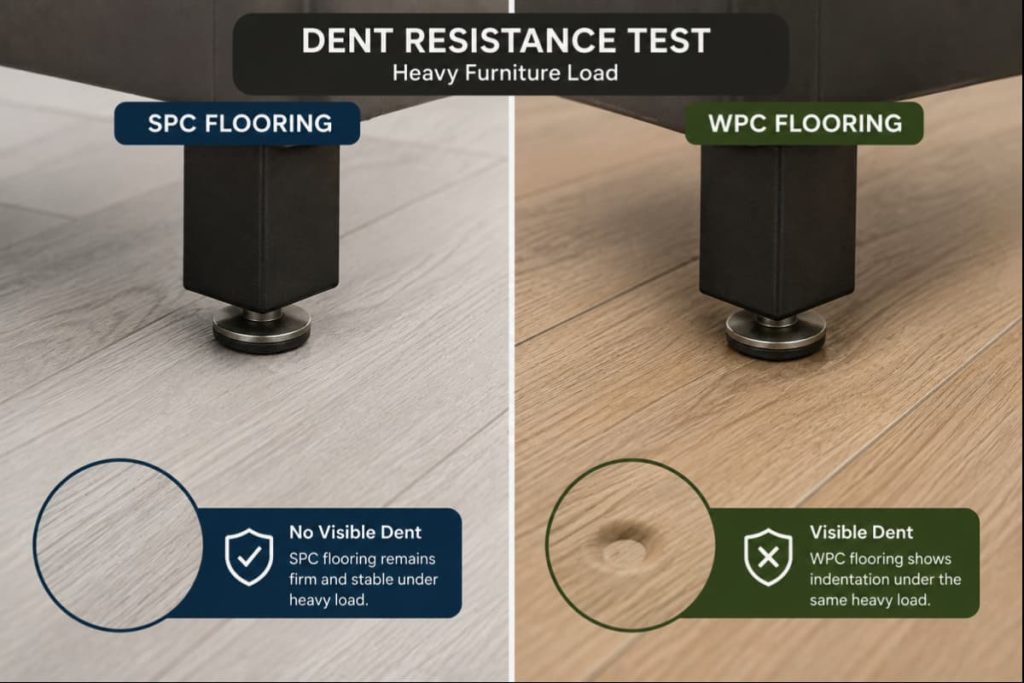
| Dent / Indentation Resistance | Excellent – resists heavy furniture and heels | Good – may show slight dents under long-term point loads | SPC significantly better |
| Scratch / Wear Resistance | Depends on wear layer (≥0.5 mm recommended) | Same – depends on wear layer | Equal (depends on wear layer) |
| Dimensional Stability | Excellent – minimal expansion/contraction | Good – slightly more movement with temperature | SPC better |
| Underfloor Heating | Excellent – preferred choice | Compatible, but stricter temperature control needed | SPC preferred |
| Sound Absorption | Moderate – usually needs extra underlayment | Better – often includes attached pad | WPC better |
| Subfloor Requirements | Higher flatness demand | More forgiving of minor imperfections | WPC more tolerant |
| Price (Material) | Generally lower (10–30% cheaper at similar specs) | Generally higher | SPC more affordable |
| Best For | Kitchens, bathrooms, basements, commercial, high traffic, underfloor heating | Bedrooms, living rooms, comfort- and quiet-focused spaces | — |
Detailed Performance Comparison
Waterproof Performance
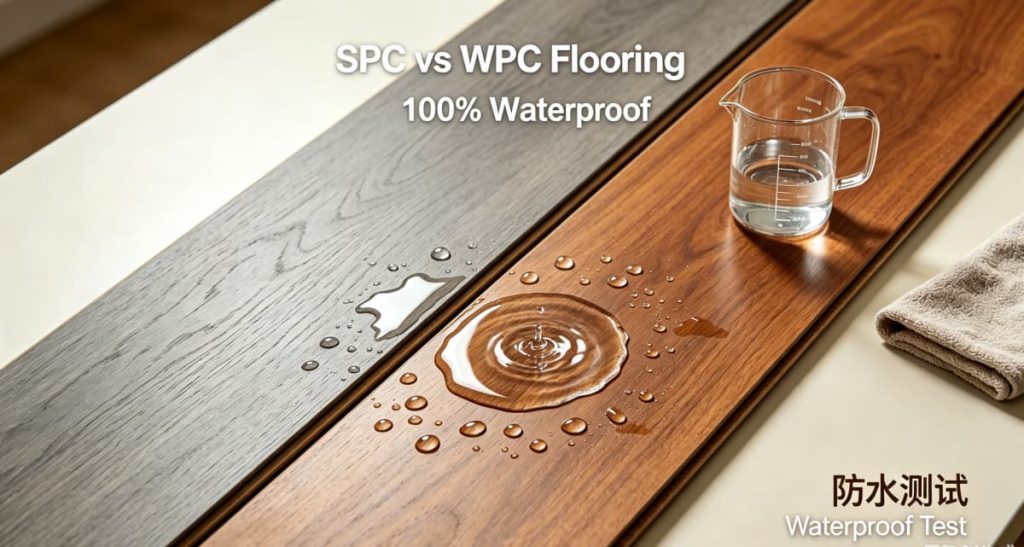
Both products are marketed as 100% waterproof and perform very well in daily residential use (kitchens, bathrooms, laundry rooms).
SPC’s inorganic stone-powder core absorbs virtually no water and shows almost no expansion even after prolonged exposure. WPC’s foamed core is also non-absorbent, but the cellular structure places higher demands on edge sealing and locking quality. If the locking system is damaged or installation is poor, WPC is theoretically more vulnerable.
Verdict: For extreme moisture environments or long-term damp conditions, SPC offers slightly higher reliability.
Underfoot Comfort and Feel
This is the most noticeable difference.
SPC feels firm and cool underfoot, similar to thin ceramic tile. It performs well in summer but can feel cold in winter when walked on barefoot.
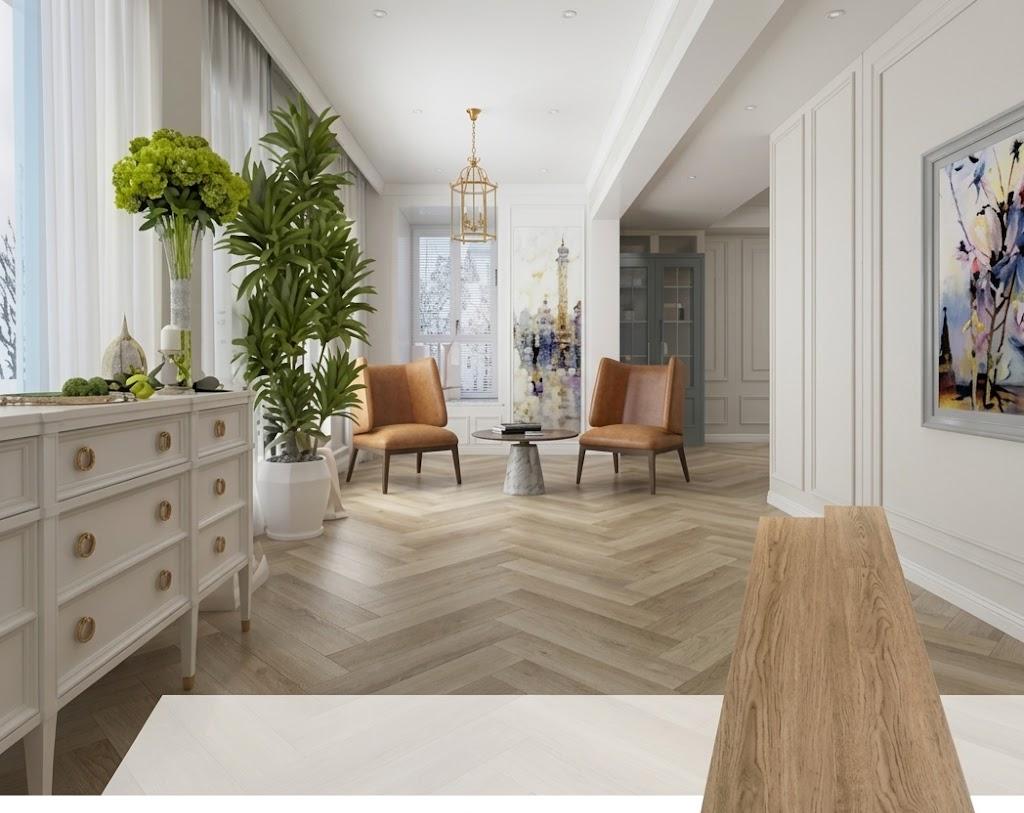
WPC’s foamed core provides slight elasticity, better warmth, and reduced fatigue during prolonged standing or walking. The sensation is closer to solid wood flooring.
Verdict: Choose WPC if barefoot comfort, warmth, or reduced standing fatigue is a priority (especially for families with children or elderly members). Choose SPC if you prefer a solid, non-yielding feel.
Durability: Dent Resistance and Scratch Performance
SPC’s high-density core delivers superior resistance to heavy furniture, office chair casters, high heels, and pet claws. WPC performs adequately but is more prone to minor indentations under sustained point loads.
Surface scratch resistance depends primarily on wear-layer thickness (commonly 0.3–0.7 mm), not the core. Under the same wear-layer thickness, long-term surface durability slightly favors SPC because the harder core provides better support.
Verdict: For homes with pets, children, heavy furniture, or commercial/high-traffic use, SPC is strongly recommended.
Dimensional Stability and Underfloor Heating
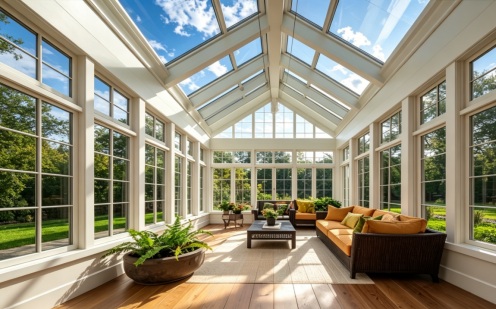
SPC exhibits minimal thermal expansion and contraction, making it ideal for spaces with large temperature swings (sunrooms, basements, underfloor heating). WPC performs well but has a slightly higher expansion coefficient under extreme conditions.
Both can be used with underfloor heating, but SPC is the industry-preferred option. Most manufacturers limit surface temperature to 27–28°C for optimal stability.
Verdict: Prefer SPC for underfloor heating, sunrooms, or areas with significant temperature variation.
Thickness, Weight, and Subfloor Requirements
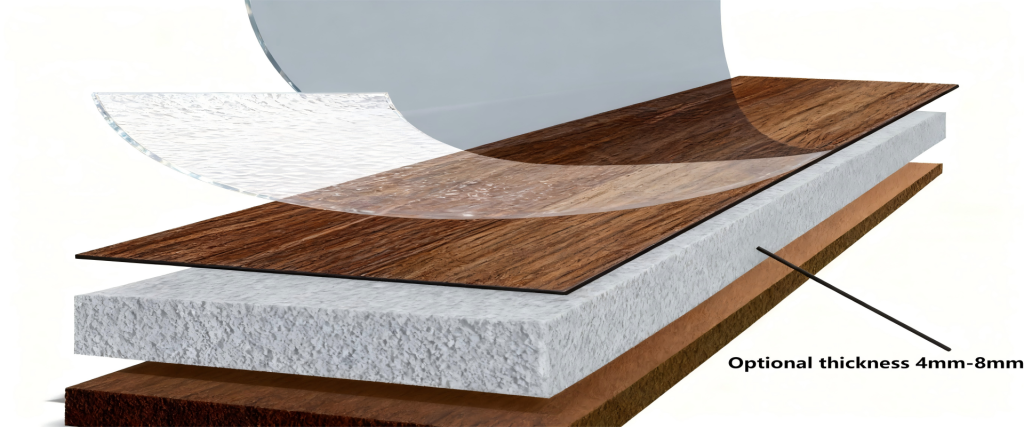
SPC is typically thinner (4–6.5 mm) yet denser and heavier per plank. The thinner profile makes door transitions easier and adds less height.
WPC is thicker (6–8.5 mm+) and better at bridging minor subfloor imperfections. It is more forgiving during installation when the base is not perfectly flat.
Verdict: Choose SPC for already-flat floors or height-sensitive projects. Choose WPC when the subfloor has slight irregularities and extensive leveling is undesirable.
Price and Value
At comparable specifications and wear-layer thickness, SPC is usually 10–30% less expensive than WPC because limestone is cheaper and the production process is more mature.
However, total value depends on wear-layer thickness, locking system quality, attached underlayment, and warranty. A low-cost SPC with only a 0.3 mm wear layer may underperform a mid-range WPC over time.
Verdict: SPC generally offers better cost-effectiveness for budget-conscious buyers. WPC is worth the premium when comfort is the top priority.
Best Choice by Room / Situation
| Room / Situation | Recommended | Reason |
| Kitchen, bathroom, laundry | SPC | Better waterproof stability and dent resistance |
| Basement, sunroom | SPC | Superior dimensional stability and temperature tolerance |
| Living room, bedroom, study | WPC | Better comfort and quieter performance |
| Homes with pets, kids, or heavy furniture | SPC | Higher resistance to dents and wear |
| Underfloor heating | SPC | Better stability |
| Commercial, rental, high-traffic | SPC | Durability and lower cost |
| Priority on barefoot comfort & quiet | WPC | Softer, warmer, better sound absorption |
Commercial Project Notes
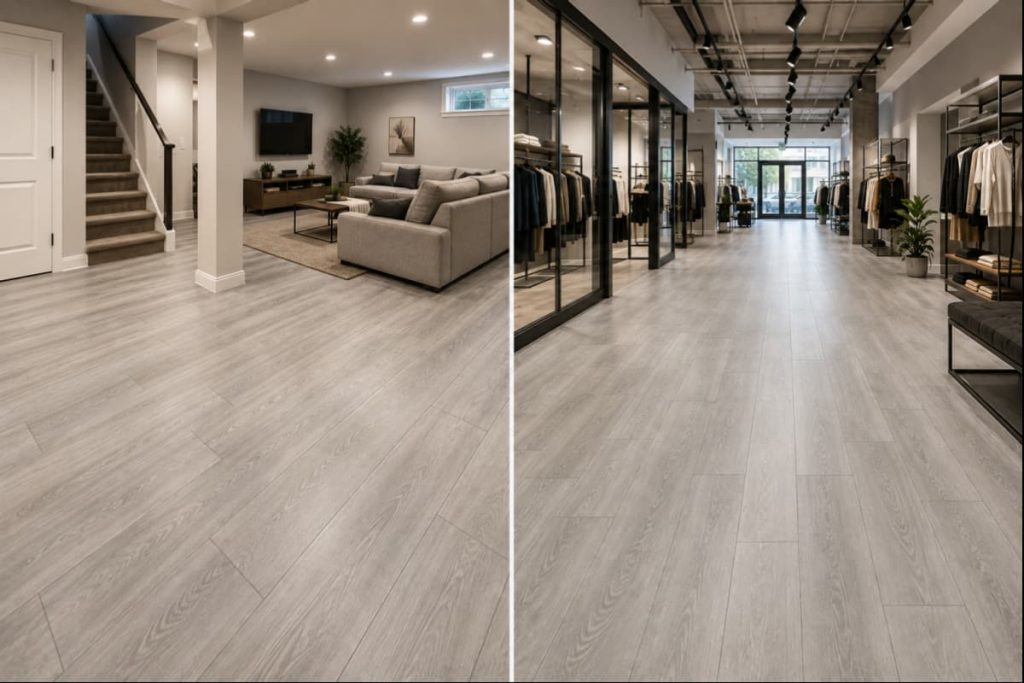
- High-traffic areas (shopping malls, hospitals, high-speed rail stations): SPC for wear resistance and lower long-term maintenance.
- Wet environments (swimming pool areas, first-floor shops in humid climates): SPC for superior moisture stability.
- Fast renovation projects (chain stores, office fit-outs): SPC’s glue-free click system often allows 40% faster installation and can go over existing floors.
- Medium/low-traffic offices or comfort-focused spaces: WPC for better underfoot feel.
- Strict environmental requirements (kindergartens, medical facilities): High-quality SPC typically offers lower formaldehyde emissions and easier compliance.
Common Myths and Procurement Pitfalls
Myths
- “Thicker is always better.” SPC is thinner but denser and often stronger. WPC uses thickness mainly for comfort.
- “Both are equally waterproof in every situation.” Daily use is comparable, but SPC holds a slight edge in extreme or long-term moisture exposure.
- “Wear resistance is determined by the core.” Wear-layer thickness is the primary factor.
Procurement Pitfalls to Avoid
- Low-price traps: Cheap SPC may use recycled materials with weak locking systems; cheap WPC may have higher formaldehyde risk. Always request third-party test reports.
- Ignoring after-sales support: Commercial projects need reliable batch supply and rapid response (ideally within 48 hours).
- Mismatching product to scenario: Confirm underfloor heating compatibility, heavy rolling loads, or humidity levels before ordering. Request targeted solutions from the supplier.
Summary: How to Choose
- Choose SPC if you prioritize stability, rigidity, dent resistance, affordability, underfloor heating compatibility, wet areas, high traffic, or commercial durability.
- Choose WPC if you prioritize softer underfoot comfort, warmth, quieter performance, and a feel closer to real wood — especially in bedrooms, living rooms, or low-to-medium traffic comfort-focused spaces.
In commercial procurement, neither material is universally superior. The correct choice is the one that best matches traffic volume, environmental conditions, installation timeline, and long-term maintenance budget.
Selecting the right core turns flooring into a long-term asset rather than a future operational burden.
If you need localized supplier recommendations, sample testing, or a customized selection plan for your project, leave a message for consultation. Chongqing HG can provide tailored procurement support.