

Best Low-VOC Flooring Options: How to Choose Non-Toxic Flooring
That new-floor scent isn’t just “brand-new building and construction” scent– it’s typically unstable organic substances (VOCs) off-gassing from adhesives, coverings, or the flooring material itself. According to the United States Environmental Protection Agency, the concentration of VOCs is consistently greater inside than outdoors, and floor coverings are among the biggest surfaces in any type of area. If you’re renovating a home — especially if you have kids, allergies or asthma in the house — knowing which Low-VOC Flooring Options actually stand up to scrutiny is more important than marketing claims. We tell you what is “non toxic flooring”, how to check it and how the different types of flooring compare.
What “Low-VOC” and “Non-Toxic” Actually Mean for Flooring
VOCs are carbon-based chemicals that vaporise at room temperature. In flooring, they are often found in the adhesives, finishes and binding resins, as well as in the base material itself – formaldehyde-based resins in composite wood products are among the most studied sources. Instead of leaving the definition to guesswork, regulators have set clear thresholds. The California Air Resources Board’s CARB Phase 2 standard caps formaldehyde emissions from composite wood products, and has established a de facto national standard outside of California.
Getting the details right here really matters. “Low-VOC” is not the same as “zero-VOC.” With low-VOC, the air release is below a stated threshold. The VOCs are not fully gone. So if a person says the floor is truly non-toxic, they should back it up with a named test standard or an issued certificate. A tag that just says “eco-friendly” or “green” does not prove it.
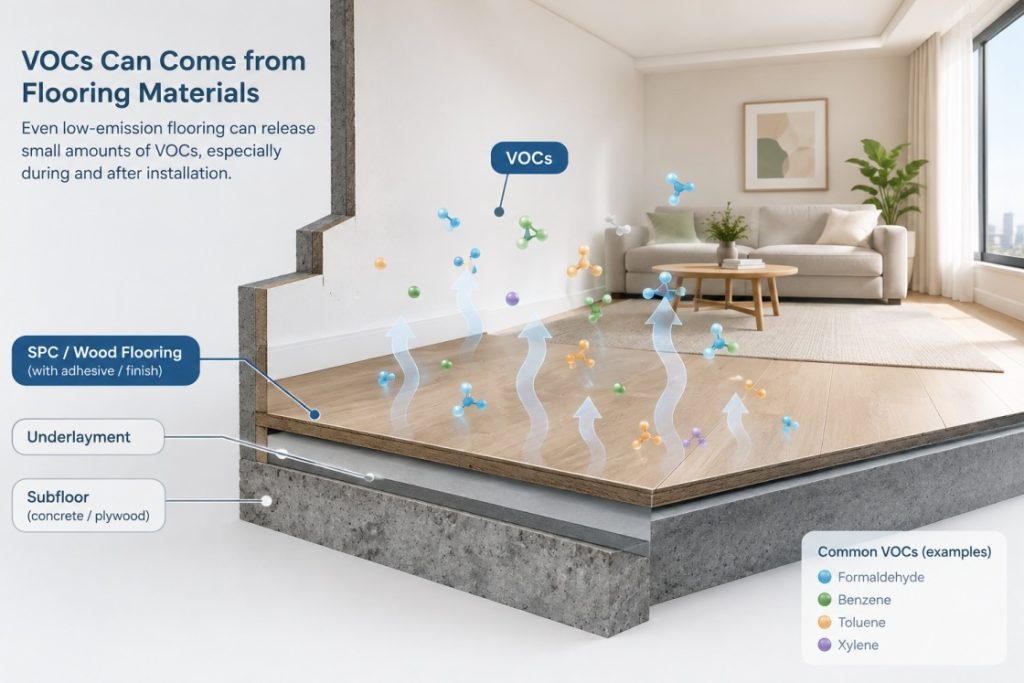
How to Make Sure a Flooring Product is Actually Low-VOC
Marketing language is easy to print, certification is harder to fake. A verified low-VOC product is three checks away from an unverified claim:
Look for established certifications. GREENGUARD and FloorScore Gold are two of the most frequently cited third-party indoor air quality certifications for flooring. They test for VOC emissions under controlled conditions. The CARB Phase 2 (or the newer federal TSCA Title VI standard, they are the same) specifically addresses formaldehyde in engineered wood products.
Request the test report (not just the certificate logo). A legitimate supplier will have a lab test summary with emission levels, not just a badge on the packaging.
Don’t rely on smell alone. Formaldehyde and other VOCs can off-gas at low, still-harmful levels without a strong odor, and conversely, some odors fade quickly without reflecting long-term emission behavior. Odor is a poor substitute for a test report.
Best Low-VOC Flooring Options Compared
1. Hard Wood Floor
Solid hardwood is basically one natural material with a surface finish. This keeps the VOC profile relatively low compared to composite products — assuming a low-VOC finish or oil is used at installation. The trade-off is the cost, sensitivity to moisture and the fact it is unsuitable for bathrooms, basements or homes with underfloor heating.
2. Stone & Tile Natural
Ceramic tile, porcelain, and natural stone are inert materials that do not off-gas VOCs themselves. The big variable to watch for is the installation materials — mortar, grout and sealants can add VOCs if they’re not specifically labelled low-emission. Tile is a good option for kitchens and bathrooms where moisture resistance is also an issue.
3. SPC (Stone Plastic Composite) Core Flooring
SPC flooring is not made of wood fibres but of a rigid core of stone powder, which changes the emissions profile compared to typical wood composite materials. The good quality SPC products are manufactured to E0-grade formaldehyde levels, the highest standard widely available, and are completely waterproof, making them a practical choice for kitchens, bathrooms and areas with underfloor heating where solid hardwood isn’t practical. SPC is a manufactured product so emissions performance will vary by manufacturer. It is therefore important to check for test documentation backed by SGS or CE rather than assuming all SPC products will perform the same.
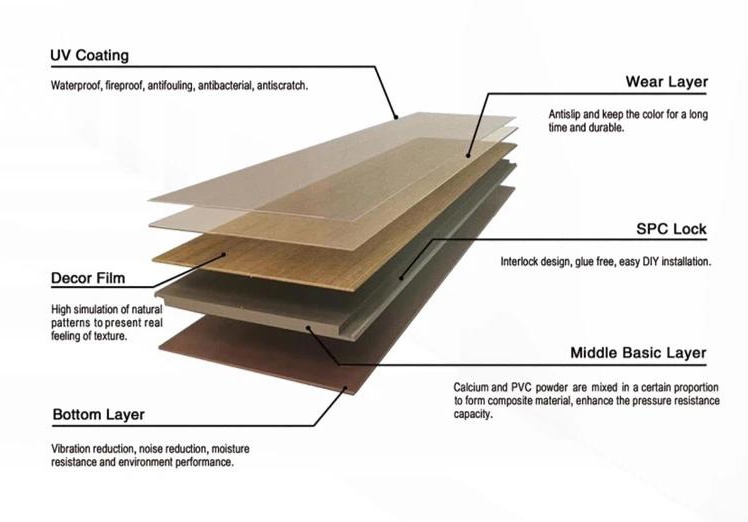
4. Low VOC Engineered Wood
Engineered wood is a real wood veneer on top of a plywood or composite base. So there are more adhesive layers than solid hardwood. In this category, the key differentiator is not the wood species but the certification since engineered wood certified to CARB Phase 2 or TSCA Title VI standards has significantly lower formaldehyde emissions than non-certified products.
5. What to Avoid: Standard Laminate and PVC Sheet Vinyl
Standard laminate floor covering typically counts on formaldehyde-based material cores, and uncertified sheet plastic can carry greater VOC content from plasticizers and backing adhesives. Neither category is automatically unsafe — but both have a wider quality range than the categories above, making certification review non-negotiable rather than optional if avoiding VOC exposure is a priority.
How to Choose the Right Low-VOC Flooring for Your Space
Choosing the right low-VOC floor can feel hard at first. The best pick usually depends on the room. There is rarely one answer that fits every space.
- Kitchens and bathrooms come with wet risk. In these areas, you want water resistance too. Tile or certified SPC often works well here.
- Bedrooms and nurseries are different. Air quality matters a lot. Lower emissions are the goal. Solid hardwood or products with GREENGUARD Gold can be a good starting point.
- For hallways, shops, or other busy spots, you need more than low emissions. You also need floors that hold up. Rigid-core SPC can last longer than softer choices in many cases.
- If you are watching the budget, you can still aim for low-VOC goals. Do not shop by price alone. Use the certification info as the main check.
A Quick Checklist Before You Buy
1) Check the certification and ask for papers, not only a logo. Look for FloorScore, GREENGUARD Gold, CARB Phase 2, or TSCA Title VI.
2) Ask the seller for the lab report on formaldehyde and VOC emissions. Get the written test result.
3) Ask what underlayment or adhesives will work with the floor. Some products can raise VOC levels even if the floor is low.
4) Before you order a full quantity, keep a sample in a locked room or closet for a few days and then review it.
5) Confirm what the core is made of. It could be solid wood, stone powder, or wood fiber. Do not rely only on the product name.
Choosing genuinely non toxic flooring comes down to combining the right base material with verified, documented certification — not a single “safest” product that works for every room. Reviewing test reports and certification details before ordering is the one step that turns a marketing claim into a verified choice.
Preventing gaps between SPC floor planks comes down to three fundamentals: proper acclimatization and subfloor prep, disciplined use of expansion gaps and spacers, and fully engaging every click-lock joint before moving on. Combine solid installation technique with a dimensionally stable, well-manufactured plank, and gapping becomes far less likely — both on day one and years into the floor’s life. If you’re sourcing SPC flooring for a project and want installation guidance specific to your product’s locking system, most manufacturers, including Huigong, provide detailed manuals and video tutorials alongside technical support to help your team install with confidence.