

Are Bamboo Charcoal Fiber Panels Really Eco-Friendly? Facts vs. Marketing
Put “bamboo charcoal” on a wall panel and most people assume the product is green. Sometimes that holds up. Often nobody has checked.
A finished panel isn’t a chunk of charcoal. It is a stack of materials: carbon filler, resin, additives, printed film and adhesive. Its footprint depends on all of them, and how it’s made, how it behaves indoors, how long it lasts and where it ends up. If you import, distribute, install or specify wall panels, that’s the lens to use before an environmental claim becomes part of your pitch.
What Are Bamboo Charcoal Fiber Panels Actually Made Of?
The Main Materials Behind the Name
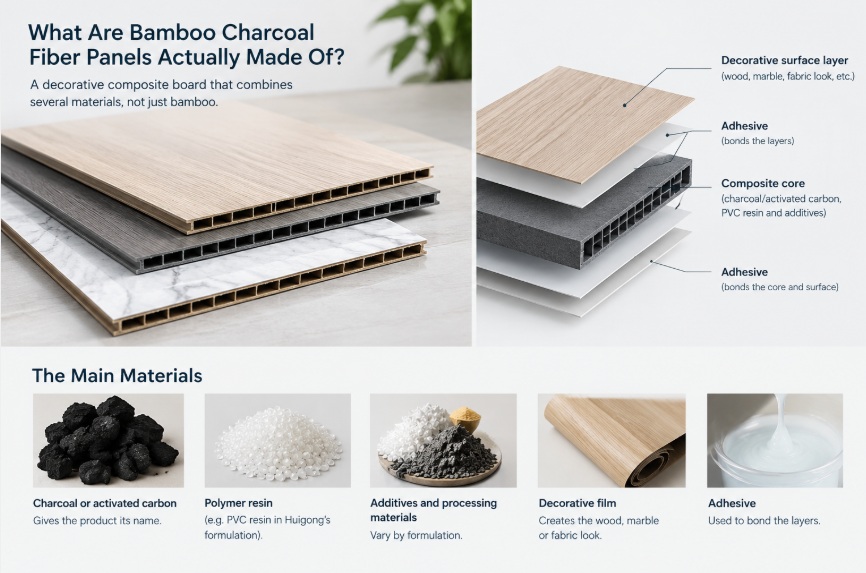
Bamboo charcoal fiber panels are decorative composite boards. Depending on the manufacturer, a panel may combine:
- Charcoal or activated carbon – the ingredient that gives the product its name
- Polymer resin – in Huigong’s listed formulation, PVC resin
- Additives and processing materials – these vary by formulation
- A decorative surface layer – a film that creates the wood, marble or fabric look
- Adhesives – used to bond the layers
The Huigong bamboo charcoal fiber wall panel page says the base material is activated carbon and PVC resin. It’s the proportions that count and they’re not usually printed on a brochure. Ask to make a declaration of material. If a supplier can’t tell you what the panel is made of, be sceptical of every other claim.
Natural Ingredients Don’t Automatically Make a Product Sustainable
Bamboo is a renewable resource. Bamboo charcoal is another thing: a processed material, made by carbonising the bamboo, which takes energy. Then it goes into a composite with decorative foil and synthetic resin. So “bamboo” is describing an ingredient, not the panel. A product with a bamboo-derived component is not necessarily natural, biodegradable or low-carbon.
So What Does “Eco-Friendly” Really Mean for a Wall Panel?
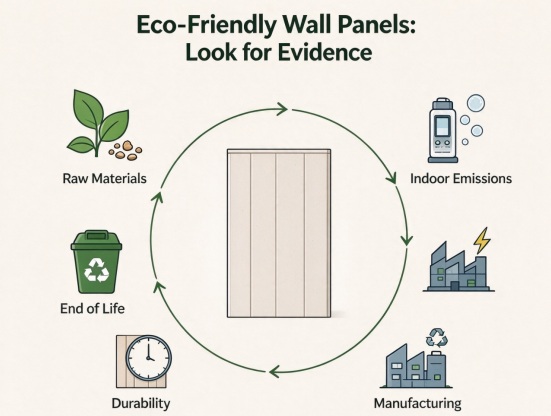
“Eco-friendly” is not a measurable thing. It is a package of separate questions, each with its own evidence.
| Environmental factor | What to ask |
| Raw materials | How much is renewable, and what is the rest? |
| Indoor emissions | Formaldehyde and VOC results for the finished panel |
| Manufacturing | Energy use and production waste |
| Durability | Service life and maintenance, with evidence |
| End of life | Can it be recycled where you are? |
Indoor Air Quality and Chemical Emissions
Begin with a distinction that stumps many buyers. Formaldehyde and total VOC (TVOC) are measured independently, so a good formaldehyde reading tells you nothing about other compounds. There is also adsorption, which is what charcoal can take up. And an emissions test measures what the panel gives off.
And then there is E0. It is a rating based on emission limits under some standard, not a promise of zero. And its meaning depends on what standard and test method it is based on. Read the headline grade first, before you read the report: what standard, what sample, what date.
Durability & Lifespan
Produces less waste with a longer lasting and less often replaced panel. That only holds if the lifetime has some test data or project history behind it. A number on a spec sheet is a supplier’s statement, not independent evidence. One might also ask how a damaged panel gets repaired or replaced.
Manufacturing and End of Life
The footprint includes energy, offcuts and polymer production. Products that are made of one material are easier to separate at end of life than layered composites. What gets recycled depends on what facilities you have in your market.
To weigh all this together you need a life cycle assessment (LCA), a method laid out in ISO 14040 and ISO 14044. It assesses impacts across defined life cycle stages within a stated system boundary. An LCA can only confirm statements about the product and conditions that it actually examined.
Bamboo Charcoal Fiber Panels: Facts vs. Common Marketing Claims
None of the claims below is automatically false. The point is to know what each one proves.
“Made with natural bamboo, so it is eco-friendly”
True of one ingredient. A finished panel also contains resin, additives and film, and the benefits of bamboo do not transfer to those.
Ask for: the share and origin of the bamboo-derived content, plus the rest of the formulation.
“Formaldehyde-free means non-toxic”
Typically, the buyers ask for the formaldehyde report first. Fair enough, but it’s for one compound, one set of test conditions, one sample. Look at three things before looking at the result. The standard used. The name of the sample matching the model you are ordering. The date of the test.
Environmental marketing language can make a product sound more sustainable than the evidence at hand supports. This is not to say that all of the claims are wrong. This means buyers need to know what each statement proves.
Ask for: formaldehyde and VOC reports on the finished panel, matched to your model.
“Biodegradable and recyclable”
Resin and decorative film do not rot just because the filler came from a plant. Recyclable in theory is also a long way from recycled in practice, since bonded layers are hard to separate and local collection has to exist.
Ask for: technical evidence of biodegradability or recycling. Without it, do not repeat the claim to your customers.
“Lower environmental impact”
Lower than what? A fair comparison needs the same function, a similar service life and the same system boundaries. Comparing a thin decorative panel with a thick structural board proves nothing. Studies on bamboo flooring or other bamboo composites also do not carry over to wall panels with a different formulation.
Ask for: an LCA or comparable data for this panel. If none exists, a supplier who says so is more credible than one who implies otherwise.
How Can Buyers Verify Environmental Claims Before Purchasing?
Here is the short version of what we would check before placing an order:
- Composition. The base material, main components and their proportions where the supplier can disclose them, plus thickness, structure and surface layer.
- Emissions reports. Formaldehyde and VOC results for the finished panel, with the standard, the issuing body and the model tested.
- Durability and end of life. Test data or project history, repair requirements, and whether the panel can be separated and sorted in your market.
- Samples and consistency. Approve physical samples for texture, thickness and color, and confirm that the reports match the model you are buying.
Two misreadings are worth avoiding. ISO 9001 certifies a quality management system, not a product’s environmental performance. SGS is a testing, inspection and certification company, so a logo alone does not tell you what was tested. Huigong’s certification page is a place to start, but confirm which documents apply to your order. If you plan custom finishes through Huigong’s customized services, ask whether existing reports still cover the modified product.
Are Bamboo Charcoal Fiber Panels a Sustainable Choice?
Possibly, for the right project. What nobody can say from the name alone is that the bamboo charcoal makes them so.
What decides it is the evidence: a disclosed composition, emissions reports that match your model, durability data you can check and an honest answer about end of life. A supplier who can show those is easier to trust than one with a green label. To see specifications, finishes and OEM options, visit Huigong’s bamboo charcoal fiber wall panels page and ask for the technical files that apply to your project.