

Best Flooring for Hotels: Room, Lobby, Bathroom, Kitchen, Entrance
A hotel floor has a rough life. It endures luggage wheels, wet shoes, cleaning machines and thousands of footsteps a day. But customers make that judgment within seconds of walking in. In reality, there is no single best hotel flooring. Each area, be it a guest room, a lobby or a kitchen has different requirements. This guide shows the best pick for each area, the standards that divide safe from risky, and where SPC flooring actually fits. Choose by zone, and one property can look premium, stay quiet and keep maintenance low.
Quick Answer: Best Flooring for Each Hotel Area
| Area | Best choice | Avoid |
| Guest room | Wood-look SPC or LVT with acoustic underlay | Solid hardwood |
| Lobby | Porcelain or stone; marble-look SPC for mid-range hotels | Polished surfaces without slip data |
| Bathroom | Textured porcelain (shower); waterproof SPC (dry zone) | Wood, standard carpet |
| Kitchen | Quarry tile, epoxy, commercial vinyl | Click-lock floors, carpet |
| Entrance | Textured porcelain or stone plus walk-off mats | Smooth polished stone |
Five Numbers to Check Before You Buy
- Wear layer: Commercial vinyl is specified in ASTM F1700 with a wear layer of at least 0.5 mm (20 mil). Thin residential grades simply won’t last: you’ll see wear in a 12-mil layer in a busy foyer in 18 months.
- Slip resistance: ANSI A137.1 requires a wet DCOF of 0.42 or higher for level interior spaces to be walked on when wet and industry guidance recommends 0.60 or higher for showers and food-preparation areas. These are comparative figures not a guaranty from slips.
- Noise: Brand standards, not code, typically target IIC 55 or better for hotel guest-room floors. Vinyl tile on bare concrete slab tests in the range of IIC 28-32, carpet with pad 50-65. Acoustic underlayment is needed under hard floors.
- •Fire performance: ASTM E648 measures the critical radiant flux of flooring: Class I is 0.45 W/cm² or higher, and general commercial guidance is 0.22 (Class II). Request the report. The requirements vary for each local code.
- Lifecycle cost: Replacing the carpet in a 135-room midscale hotel was estimated to cost almost $100,000 and could take areas out of service for days or weeks. Price per square meter, judged per year of service.
Best Flooring for Hotel Rooms
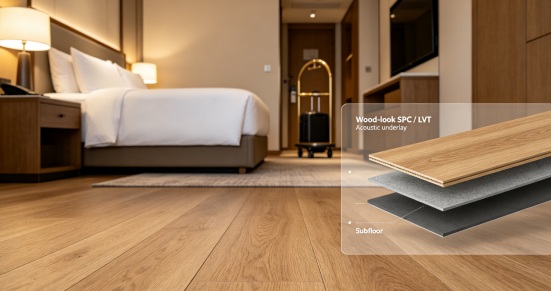
Our top recommendation: Wood-look SPC or LVT with acoustic underlay More hotel brands are now specifying LVT for guest rooms, but acoustic underlayment is a hidden added cost as vinyl transmits more sound than carpet. Get ready for it. Carpet tile is still the quietest option. Avoid solid hardwood. It is easily damaged by water and spills, luggage wheels will scar it and it does not absorb sound well.
Best Flooring for Hotel Lobbies
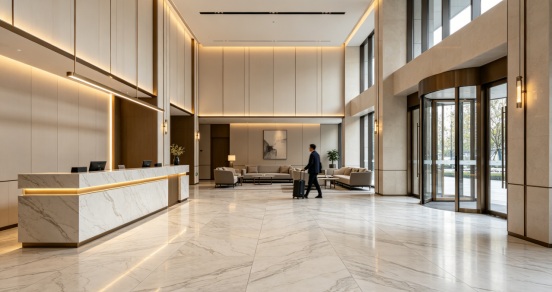
Finest choice: porcelain or all-natural stone for front runner buildings; marble-look SPC for mid-range hotels. The lobby establishes the first impression and takes the heaviest web traffic. Whatever you select, check the damp DCOF, since rain and wiping make lobbies a wet-floor area in practice. Large-format tiles or lengthy slabs also mean fewer joints to tidy.
Best Flooring for Hotel Bathrooms
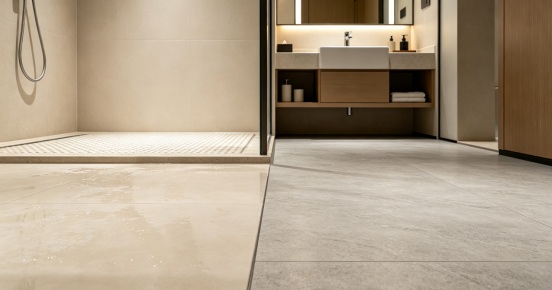
Top choice: use textured porcelain in the shower area. In the dry part, choose waterproof SPC or LVT. Since guests may walk on the shower floor barefoot, target a slip rating around 0.60 DCOF or higher. Outside the wet zone, a waterproof rigid-core floor feels warmer underfoot than tile. Seal the perimeter either way.
Best Flooring for Hotel Kitchens
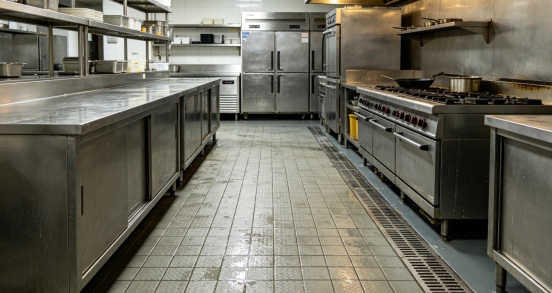
Best pick: quarry tile, epoxy or commercial-grade vinyl. Grease and constant washing make this the harshest zone in the building, and the 0.60 DCOF benchmark applies. We would not specify click-lock planks here: joints, heat and grease are the wrong mix.
Best Flooring for Hotel Entrances
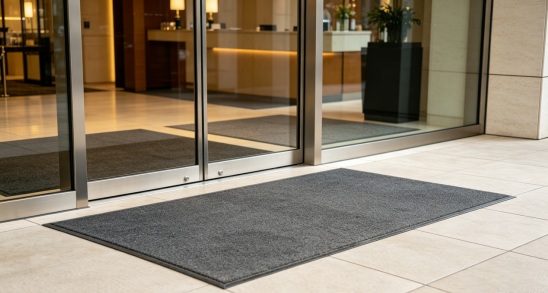
Best pick: textured porcelain or natural stone, paired with walk-off mats. Mats catch grit and water before they reach your lobby floor. In covered vestibules, carpet tiles work well because damaged squares can be replaced individually.
Hotel Flooring Compared
| Material | Water resistance | Noise control | Install speed | Best areas |
| SPC | Excellent | Good with underlay | Fast | Rooms, corridors, lobbies |
| LVT | Very good | Good with underlay | Fast | Rooms, corridors |
| Porcelain | Excellent | Poor | Slow | Bathrooms, lobbies, entrances |
| Natural stone | Good (sealed) | Poor | Slow | Lobbies, entrances |
| Carpet tile | Poor | Excellent | Fast | Rooms, corridors |
| Hardwood | Poor | Fair | Medium | Boutique lounges only |
Where SPC Flooring Fits in a Hotel
SPC (stone plastic composite) features a solid limestone core that will not swell, making it a good choice for hotels looking for waterproof floors without the cost and downtime of tile. Huigong’s SPC is a 6-layer product with a wear layer of 0.3-0.7 mm and an underlay pad of IXPE/EVA. Many color and look options. Planks from 6″×36″ to 9″×70″, or customized.
Where it works: Guest rooms, corridors, mid-range lobbies and dry bathroom areas.
Where it doesn’t: commercial kitchens, shower floors and exposed entries. Use tile in those areas.
The practical advantage is the speed of renovation.” Click-lock planks go down without glue and in many cases over existing tile, concrete or vinyl if the subfloor is clean, dry and level. This means we refurbish floor by floor and not long closures.
What to ask of any supplier, including us: wear layer of at least 0.5 mm for hotel use, plus test reports for wet DCOF, ASTM E648 fire class and IIC with your chosen underlay. Huigong provides OEM/ODM customization and free samples, so you can try a plank before committing yourself.anded over.
FAQ
What is the most durable flooring for hotels?
Porcelain tile and natural stone last longest in wet, heavy-traffic areas. For guest rooms and corridors, commercial vinyl-based floors with a 0.5 mm or thicker wear layer offer the best balance.
Is SPC flooring a good fit for hotels?
Yes, it can work well in hotel rooms, hallways, and other dry public spaces. Make sure the wear layer is commercial grade. Also confirm you can get test data.
What is the usual best choice for hotel rooms?
Many hotels pick wood-look SPC or LVT that includes an acoustic underlay. Carpet tile is also a solid option if you want more sound control.
What slip rating should I request?
For indoor spaces that stay level, ask for a wet DCOF of 0.42 or more. For showers and kitchens, request a wet DCOF of 0.60 or more.
Match each floor to its job: tile where water and grease rule, rigid vinyl where comfort and speed count, mats where the outdoors comes in. Check the numbers, not the brochures. Want SPC in your project? Request free samples or a quote.