

What Is SPC Flooring? A Factory Explains Structure, Layers & Quality
In recent years, SPC flooring (Stone Plastic Composite Flooring) has become increasingly popular as a flooring material for both home renovations, office renovations, and commercial projects such as hotels and shopping malls. It not only has a realistic wood grain or stone appearance, but also possesses advantages such as water resistance, wear resistance, easy installation, and easy maintenance. Therefore, it is widely used in various indoor spaces.
However, for many people, when they first encounter SPC flooring, they may have similar questions:
- What exactly is SPC flooring?
- How is it different from wood flooring, laminate flooring, and PVC flooring?
- Is SPC flooring really worth purchasing?
This article will provide you with a comprehensive understanding of SPC flooring and help you choose the floor product that suits you best.
Where Does the Name “SPC” Come From?
SPC stands for Stone Plastic Composite (sometimes written as Stone Polymer Composite). In Chinese markets it’s commonly called 石塑地板 or 石晶地板.
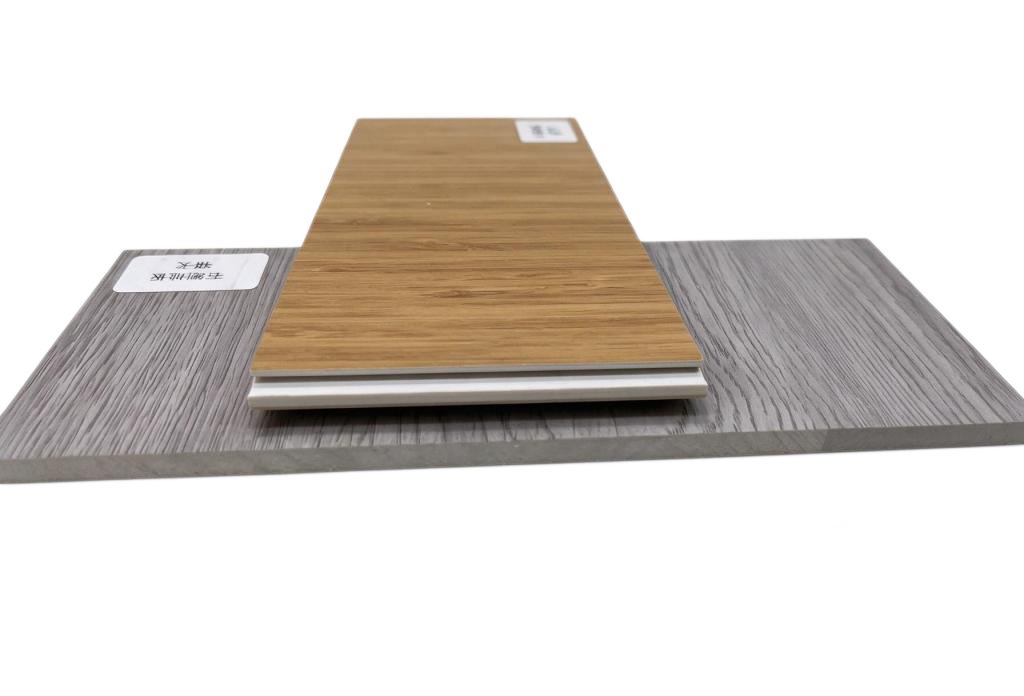
It has fundamental differences from the types of flooring we are familiar with:
- Compared with traditional LVT (elastic plastic flooring): The core of LVT is soft PVC, while the core of SPC is high-density rigid stone plastic.
- Compared with WPC (wood-plastic composite flooring): WPC uses wood powder + PVC, while SPC uses stone powder + PVC.
- Compared with ultra-durable flooring (Laminate): The core of ultra-durable flooring is high-density fiberboard (HDF), which is essentially wood and water-resistant; the core of SPC contains no wood fibers at all.
In a nutshell: SPC is a rigid composite flooring made with a high proportion of natural stone powder as the framework and PVC resin as the adhesive. Its essence lies not in the beautiful wood grain on the surface, but in the hard and dense stone plastic core in the middle.
Core Raw Materials: What Roles Do Stone Powder and PVC Play?
SPC is called “stone-plastic” because its rigid core is built from two main components:
1. Stone Powder
Typically accounts for 60–75% (sometimes higher in cost-optimized formulations). It provides hardness, rigidity, compressive strength and dimensional stability. However, higher stone-powder content lowers cost but increases brittleness. Excessively high calcium content makes the core easier to break at the lock and more prone to arching after installation.A good-quality core shows a dense, uniform cross-section when cut. Coarse particles or visible air bubbles are warning signs of uneven mixing or poor process control.
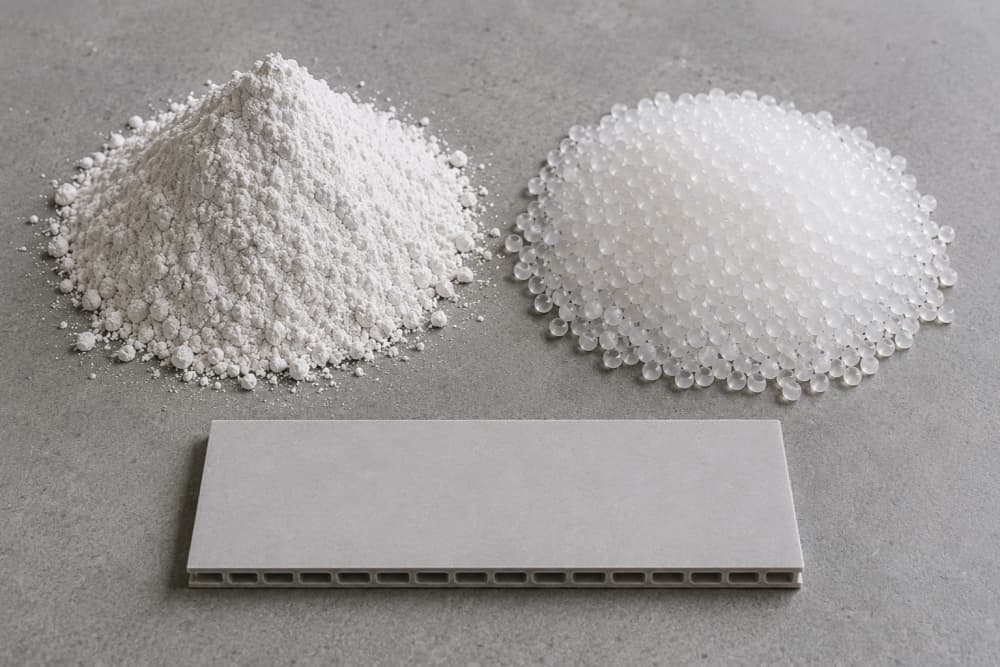
2. PVC Resin (Polyvinyl Chloride)
Accounts for approximately 20–30%. It acts as the binder that holds the stone powder together, giving the material waterproofing properties and the necessary toughness for processing and locking performance.
The balance between stone powder and PVC is critical. Too much stone powder reduces cost but compromises impact resistance and lock integrity; too little reduces rigidity and dimensional stability. High-quality manufacturers maintain strict formula control and continuous mixing to achieve consistent density (typically 1.9–2.1 g/cm³).
Simple on-site quality check: Break a corner lock by hand. A clean, relatively tough break is preferable. A highly brittle fracture that snaps easily usually indicates an overly high stone-powder ratio and lower overall durability.
The Complete Layer Structure of SPC Flooring
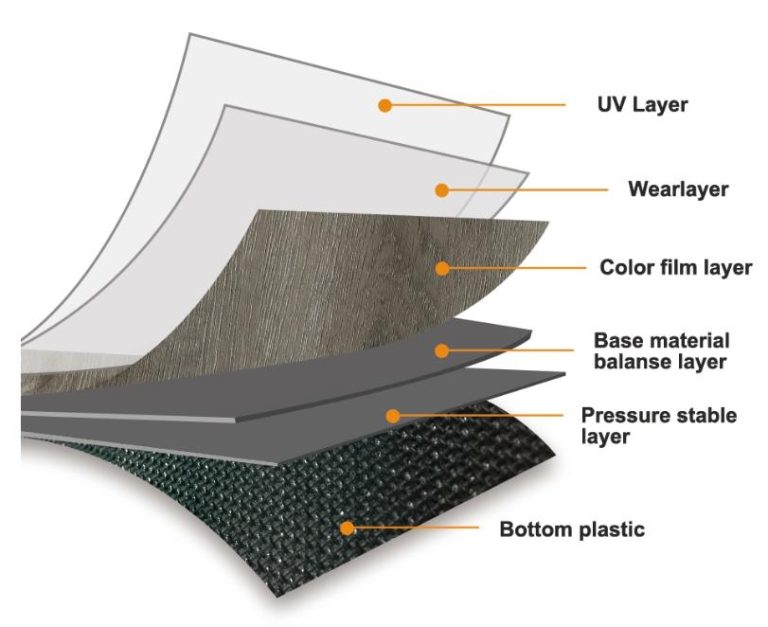
A complete SPC floor typically consists of five functional layers from top to bottom:
- UV Coating – The outermost protective film. It resists scratches, stains and UV yellowing. Insufficient UV curing (too few passes) can lead to whitening in high-traffic areas over time.
- Wear Layer – Transparent PVC layer that determines long-term abrasion resistance. Thickness commonly ranges from 0.3 mm to 0.5 mm (or higher for commercial use). The same total plank thickness (e.g., 4 mm or 5 mm) can have very different wear-layer thicknesses, resulting in completely different abrasion revolutions. Always specify the exact wear-layer thickness and abrasion grade in the contract.
- Printed Decorative Layer – High-resolution film that creates the wood, stone or concrete appearance. Advanced products use embossed-in-register (EIR) technology for realistic texture matching.
- SPC Core Layer – The high-density rigid substrate formed by one-step hot extrusion of stone powder and PVC. This is the heart of the product. Density, uniformity and internal porosity directly determine waterproofing, compressive strength and dimensional stability.
- Backing / Underlayment (optional) – IXPE, EVA or cork layer for sound absorption, slight comfort improvement and moisture buffering.
In terms of total thickness, the mainstream products currently available on the market are mostly between 4 and 7 mm. It should be noted that: total thickness is not necessarily the thicker the better. The core density and the thickness of the wear-resistant layer are often more important than just the millimeter figure.
Further Reading: How to choose SPC flooring for your business
Manufacturing Process: Why Is the Structure So Stable?
The core is not laminated with glue in multiple steps. Instead, it is formed in a continuous high-temperature extrusion process:
Precise high-speed mixing of raw materials → High-temperature extrusion into dense sheets → Controlled cooling and shaping → Precise alignment and hot-press lamination of decorative film + wear layer → UV coating → Precision profiling of the click-lock system → Cutting and final quality inspection.
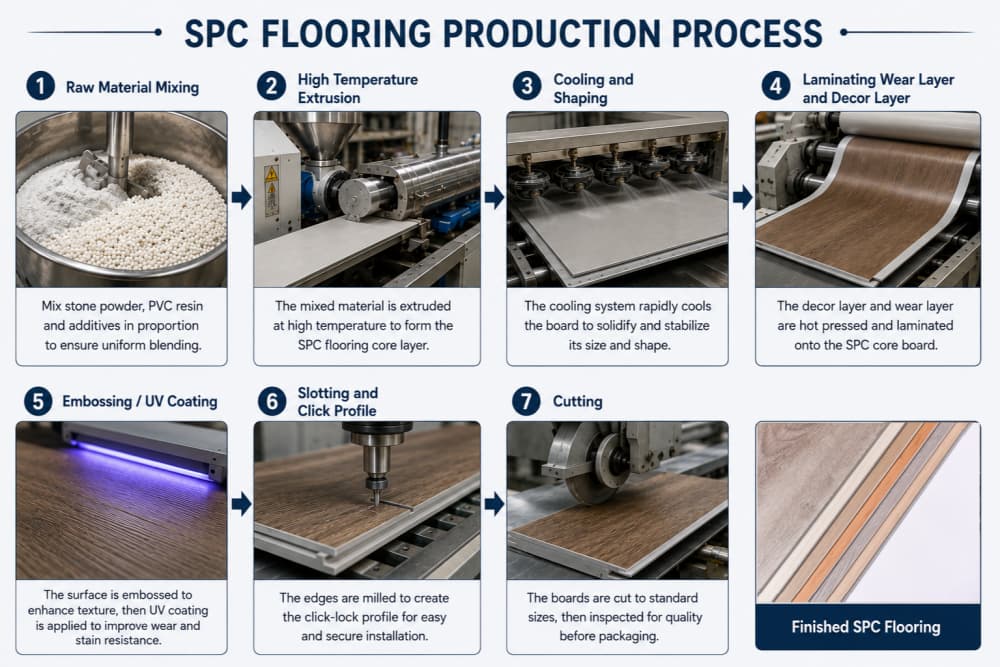
Key process points that affect long-term performance:
- Hot-press bonding strength: Weak lamination may not show problems in the first months but can lead to surface peeling or edge cracking after one to two years of use.
- Lock mold precision: Tight tolerance locks install faster and have lower breakage rates. Large-tolerance locks increase labor time, material waste and schedule risk—costs that ultimately fall on the project buyer.
- Batch consistency: Color and density variation between production batches is one of the most common causes of large-area installation failure. Factory-direct production with controlled capacity and inventory allows better same-batch delivery for a single project.
How the Structure Determines Performance
If you connect the above structures together, you can clearly see where the performance comes from:
- 100% waterproof: The core is made of wood-free fibers and has almost no pores, so water cannot cause expansion or mold.
- High dimensional stability: The thermal expansion and contraction coefficient of the stone powder is extremely low, making it suitable for spaces with large temperature differences (such as south-facing areas, underfloor heating, balconies, and basements).
- Resistant to compression and indentation: High density and good rigidity make it significantly more resistant to heavy furniture, high-heeled shoes, and pet claws than traditional soft plastic flooring.
- Strong locking mechanism: The rigid core makes the clips fit more securely, and they are less likely to loosen over time.
- Harder to the touch: This is an inevitable result of the rigid structure. People who prefer a soft touch might prefer WPC or improve the situation by adding thick sound-absorbing pads.
A simple comparison with common flooring is as follows:
| Property | SPC | WPC | Laminate | Solid Hardwood |
| Core Material | Stone powder + PVC | Wood flour + PVC | High-density fiberboard | Natural wood |
| Water Resistance | 100% | 100% | Poor | Poor |
| Underfoot Feel | Firmer | Softer | Medium | Warm and resilient |
| Dimensional Stability | Excellent | Good | Medium | Lower |
| Indentation Resistance | Excellent | Good | Good | Fair |
Key Quality Factors and Practical Procurement Advice
When evaluating SPC flooring—especially for commercial or large residential projects—focus on the following controllable points:
- Core formula and density
Request a cross-section sample. A dense, uniform cut without coarse particles or bubbles indicates better mixing and process control. Avoid cores that feel overly brittle when the lock is broken. - Wear layer thickness and abrasion rating
Never rely only on total plank thickness. Specify the exact wear-layer thickness (e.g., 0.3 mm / 0.5 mm) and corresponding abrasion revolutions or commercial grade in the contract. This is the single most important factor for long-term surface durability. - Lock precision and installation efficiency
Poor lock tolerance increases breakage rate and slows installation. Ask for installation samples or video of the locking process to assess ease of use. - Lamination and UV quality
Insufficient bonding strength or inadequate UV curing may only become visible after 12–24 months through peeling, edge cracking or surface whitening in high-traffic zones. - Production capacity and batch consistency
Prefer manufacturers with their own production lines and warehouse capacity. This significantly improves the probability that a single project order comes from the same production batch, reducing visible color variation across large areas. Some common specifications may be held in stock—confirm actual inventory rather than relying solely on quoted lead times.
Recommended practical checks before finalizing a large order:
- Inspect the core cross-section
- Physically break a lock sample
- Write clear wear-layer thickness and abrasion grade into the contract
- Request video confirmation of the actual production line
- Contractually require same-batch delivery for the project
How long can SPC Flooring Last?
How Long Can SPC Flooring Last?
High-quality SPC flooring typically lasts 15–25 years in residential use and 10–20 years in commercial environments when properly installed and maintained. Actual lifespan depends heavily on wear-layer thickness, core quality, installation accuracy and daily care—not only on the total millimeter thickness.
The main factors affecting lifespan include:
- Thickness of the wear-resistant layer
- Product quality
- Installation process
- Usage frequency
- Daily maintenance habits
Therefore, in addition to choosing high-quality products, correct usage and maintenance are equally important.
Conclusion
As people’s demands for the quality of living environment continue to rise, SPC flooring, with its advantages such as waterproofing, wear resistance, stable dimensions, easy installation and simple maintenance, has become an important choice for modern interior decoration.
Whether it is a family residence or a commercial space, as long as the appropriate thickness, wear-resistant layer and surface design are selected based on actual needs, and combined with proper installation and daily maintenance, SPC flooring can provide a long-term stable, beautiful and comfortable usage experience.
If you are looking for a flooring material that combines quality, beauty and durability, you may want to explore different specifications and series of SPC flooring products to find a more suitable solution for your next decoration project.