

WPC Fluted Wall Panels for Home Theaters: Style & Acoustic Benefits
In today’s era of seeking immersive viewing experiences, a home theater no longer merely involves “putting up a TV or projector”. Clear dialogue, balanced surround sound, advanced spatial atmosphere, and durable walls have become the core demands of an increasing number of homeowners. Traditional gypsum boards, wallpaper, or ordinary wood veneers often fail to meet these requirements simultaneously – either they tend to cause echoes, or they get damp and deform, or they are troublesome to maintain.
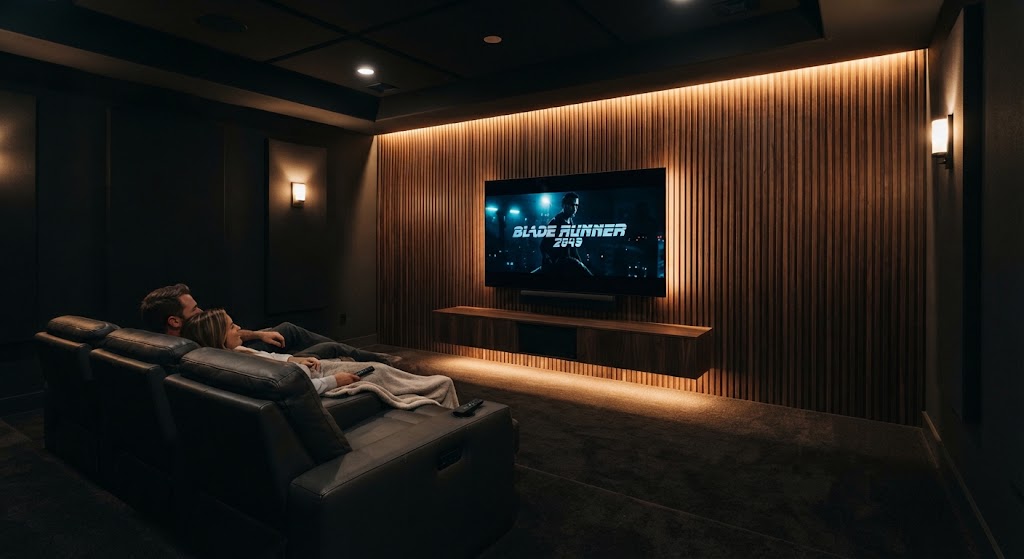
WPC fluted wall panels (Wood Plastic Composite fluted or slatted panels) have emerged as a practical and stylish solution. It retains the warm texture of wood while possessing excellent moisture-proof, durable, and acoustic diffusion properties, allowing the space to be enhanced both visually and auditorily.
What Are WPC Fluted Wall Panels?
WPC stands for Wood Plastic Composite, which is a type of material made by mixing wood fibers (or bamboo fibers) with plastic polymers (such as PVC) in a certain proportion and then extruding them at high temperatures. It has the natural texture and feel of wood, while inheriting the waterproof, pest-resistant, and deformation-resistant properties of plastic.
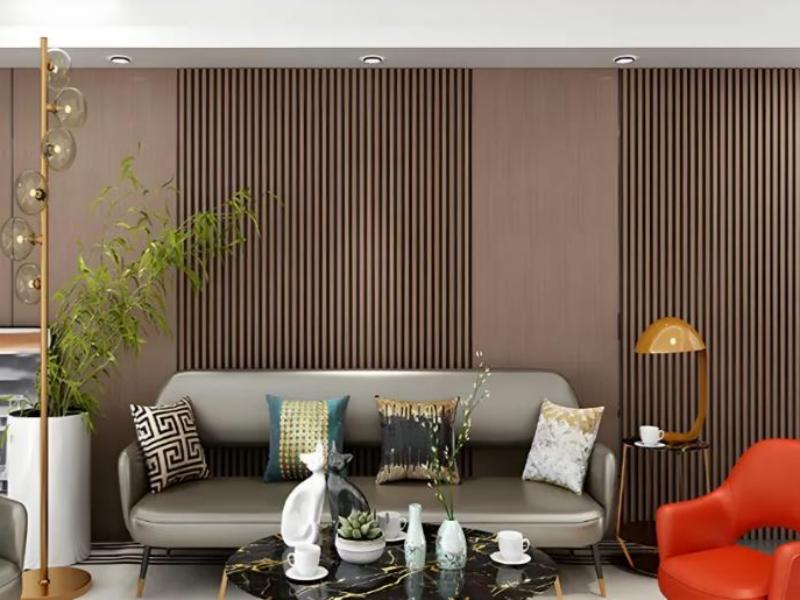
“Fluted” refers to the continuous vertical or linear groove design on the surface. These grooves create a three-dimensional texture, which produces rich light and shadow effects when illuminated by light. Visually, it can heighten the space, increase the sense of depth, and break the monotony and flatness of the wall. Compared to traditional solid wood grilles, the WPC version is lighter, more stable, and almost maintenance-free; compared to ordinary PVC boards, it is closer to the advanced texture of real wood.
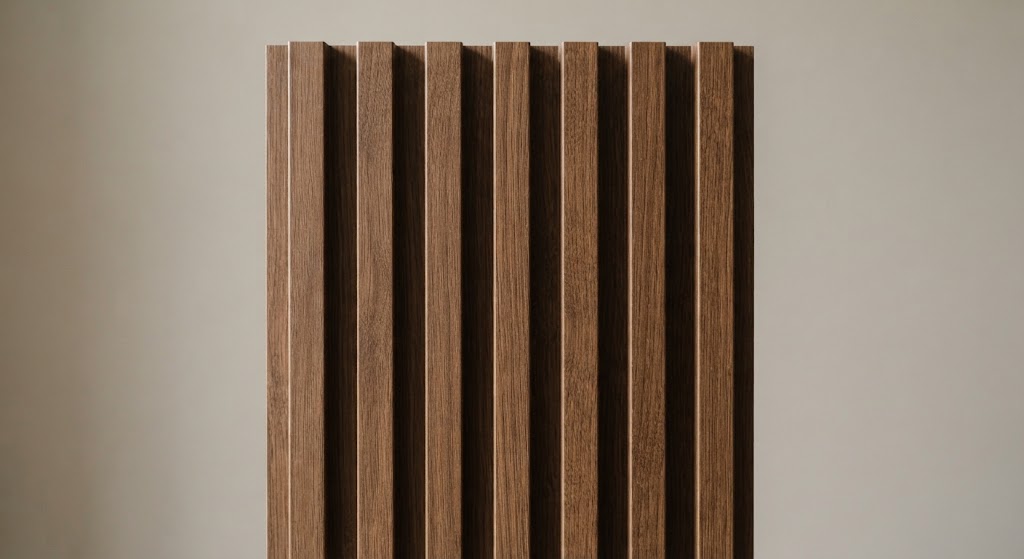
Common specifications include thickness ranging from 6 to 20mm, width approximately 150 to 600mm, and length 2.4 to 3 meters. The colors available include walnut, oak, dark gray, black, and many others. Some products also support customization.
Why WPC Fluted Panels Work Especially Well in Home Theaters
The requirements for wall materials in a home theater are far more demanding than those for a standard living room or bedroom, and WPC corrugated panels excel in several key areas.
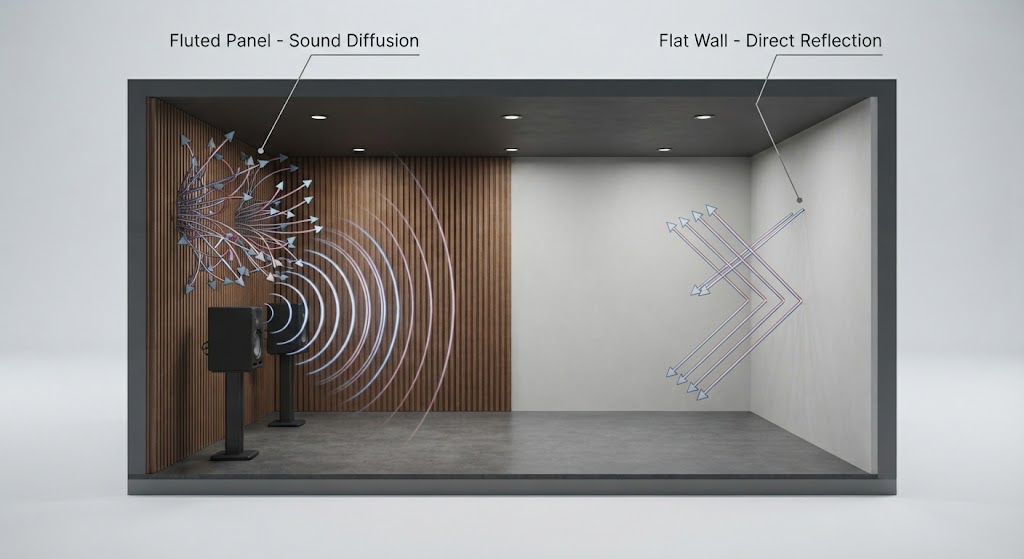
Acoustic optimization: moderate diffusion, reducing harmful reflections
The audio-visual room is most susceptible to the early reflections and flutter echoes caused by hard, flat walls. The grooved structure of WPC fluted panels can effectively disperse sound waves, achieving a diffusion effect and making the sound distribution more uniform. When paired with sound-absorbing felt or PET fibers as a backing, it can further absorb some mid-to-high frequency energy, enhancing the clarity of conversations and the immersion of surround sound. Although it is not a professional-level completely soundproof material, as a “diffusion + moderate absorption” daily solution, it has high cost-effectiveness and is particularly suitable for use on the front, side, and rear walls.
Visuals and Atmosphere: A Blend of Sophistication and Immersion
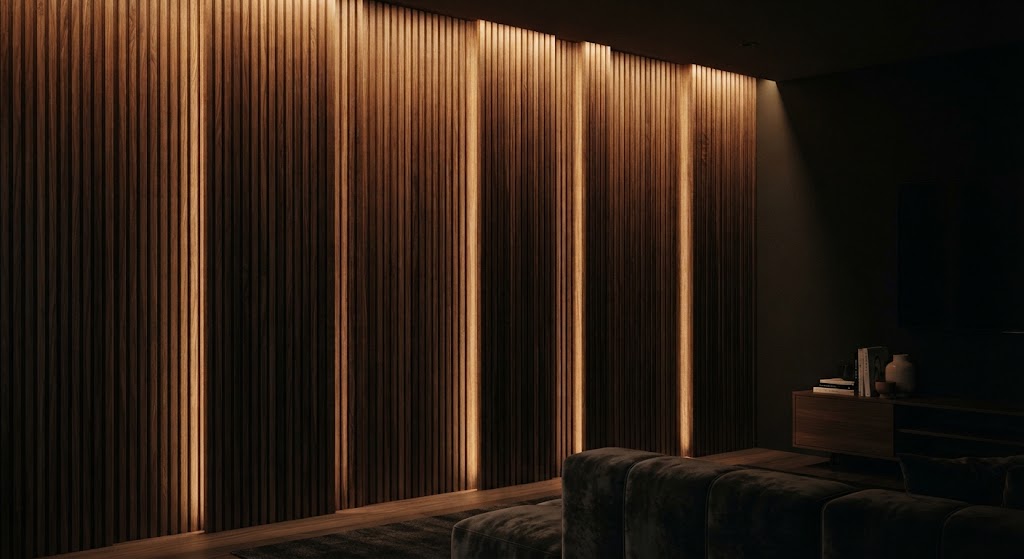
Vertical lines can visually increase the height of the space. Dark colors (such as black walnut and dark gray) are particularly suitable for the dim atmosphere of a cinema. Light colors give a more modern and minimalist look. When LED light strips are embedded in the grooves or at the top and bottom, the light and shadow effects are highly dramatic, creating a professional cinema atmosphere during night screenings. At the same time, the three-dimensional walls can ingeniously hide cables and equipment interfaces, making the space more tidy.
Practical Performance: Durable, moisture-resistant, low-maintenance.
Home theaters are usually located in basements or relatively enclosed spaces, where the humidity and temperature fluctuate greatly. WPC materials are moisture-proof, mold-proof, pest-proof, and resistant to deformation. Their lifespan typically ranges from 10 to 20 years. The surface is scratch-resistant and easy to clean. Daily maintenance only requires wiping with a damp cloth. Most products have excellent flame-retardant properties (commonly B1 grade or equivalent standards), and their environmental protection indicators can meet low formaldehyde or even zero formaldehyde requirements.
Value
Compared with full-house custom solid wood work or professional acoustic panel systems, WPC waveboard is more controllable in terms of material cost and construction difficulty. At the same time, it can also balance aesthetics and some acoustic functions. In the long run, it has outstanding cost-effectiveness.
Recommended Applications and Design Tips
- Front wall (behind the screen or TV) — The most recommended position. As the main visual focal point, it can not only enhance the sense of sophistication but also hide the wiring, making the equipment integration more seamless.
- Side and rear walls — Focus on improving reflected sound to help achieve a more balanced sound field. They can be partially tiled or used in combination with sound-absorbing cotton, fabric soft furnishings.
- Ceiling accents or partial walls — Enhance the overall unity, avoiding the space from feeling too oppressive.
Design considerations:
- Vertical orientation is most common and enhances the sense of height. Horizontal installation can make a narrow room feel wider.
- Lighting is critical. Recessed or surface LED strips in warm or tunable white tones dramatically improve the evening atmosphere.
- Combine hard and soft surfaces: use the fluted panels for diffusion and visual interest, and pair them with carpet, heavy curtains, and upholstered seating for absorption.
- Color coordination with the screen bezel, speakers, and furniture creates a unified look.
- In smaller rooms, a single feature wall often works best. Larger rooms can support coverage on two or three walls.
Buying and Installation Guidelines
What to look for when purchasing
Check the material composition, formaldehyde/VOC emissions, fire rating, panel thickness, and groove depth. For better acoustic performance, choose models with an integrated felt or fiber backing. Verify color consistency, dimensional accuracy, and manufacturer support.
Installation notes
The wall surface should be flat and dry, with appropriate expansion joints reserved. Common installation methods include direct glue bonding, light steel keels or special clips. Before construction, it is essential to coordinate with the electrical system, audio cables, and projection holes. The lightweight nature makes DIY possible, but for large-scale or projects with high precision requirements, it is recommended to be carried out by professional construction teams.
Common mistakes to avoid: treating the panels as full soundproofing, neglecting lighting and soft furnishings, or selecting overly thin or low-quality products that may warp over time.
Conclusion
WPC fluted wall panels offer a practical middle ground for home theaters and AV rooms. They improve visual quality, provide useful acoustic diffusion, and deliver reliable long-term performance with low maintenance. They are not a complete professional acoustic system, but for most residential projects they represent one of the most effective and accessible upgrades available.
If you are planning or renovating a media room, consider WPC fluted panels as a strong candidate for the walls. With the right product selection, thoughtful lighting, and balanced soft treatments, they can meaningfully elevate both the look and the listening experience of your space.